Most people searching for StealthGPT AI want the answer to one question. Which AI humanizer can take machine-written text, make it read like a person wrote it, and do it without flattening the meaning into mush? StealthGPT is one of the loudest names in the undetectable-AI space. But being well known and actually working are two separate things, and the gap between them is the whole point of this comparison.
We put StealthGPT AI next to EssayTone and looked at what the numbers say. If you only take one thing away: these tools are built for different jobs, and that difference matters more than anything either one puts on its homepage.
What StealthGPT AI Is Built To Do
StealthGPT AI sells itself as an everything platform. It's an AI humanizer, an AI detector, an SEO writer, and a content generator stuffed into one subscription. The headline promise is that it rewrites AI text so it gets past Turnitin, GPTZero, Originality.ai, and Copyleaks. The target audience is wide: students writing papers, marketers pumping out long-form, freelancers chasing volume.
That breadth is the pitch. It's also the problem. When a tool tries to be a bypasser, a checker, and a writer all at once, the humanizing engine has to share a roadmap with five other features. The thing most people actually showed up for ends up competing with everything else for attention.
And the independent testing on that humanizing engine has not been kind. Reviews published through late 2025 and into 2026 ran StealthGPT's output back through the major detectors and watched it get caught. Originality.ai's own test returned a "100% confidence, likely AI" verdict on StealthGPT-humanized text. A separate six-detector review in 2026 found the rewritten text still scoring as high as 86% AI on Turnitin and 100% on Originality.ai. A third reviewer reported both GPTZero and Turnitin flagging the "stealthed" version as fully AI, and pinned the failure on recent detector updates that StealthGPT hadn't kept pace with.
That last detail is the real story. The detectors got smarter. StealthGPT mostly stayed where it was.
What EssayTone Is Built To Do
EssayTone made the opposite bet. Instead of being a toolkit, it does one thing: turn AI-generated essays into natural, human-reading text while keeping the original meaning intact. No detector module, SEO writer, quiz genertor is bolted on, just the humanizer. That narrow focus is the entire design, and it's the reason the results look the way they do.
To actually test it instead of just claiming things, we built a benchmark framework specifically for evaluating AI humanizers for essays. Not a quick spot-check on a couple of paragraphs, but a repeatable methodology you can push any humanizer through and get comparable numbers back.
How We Tested It
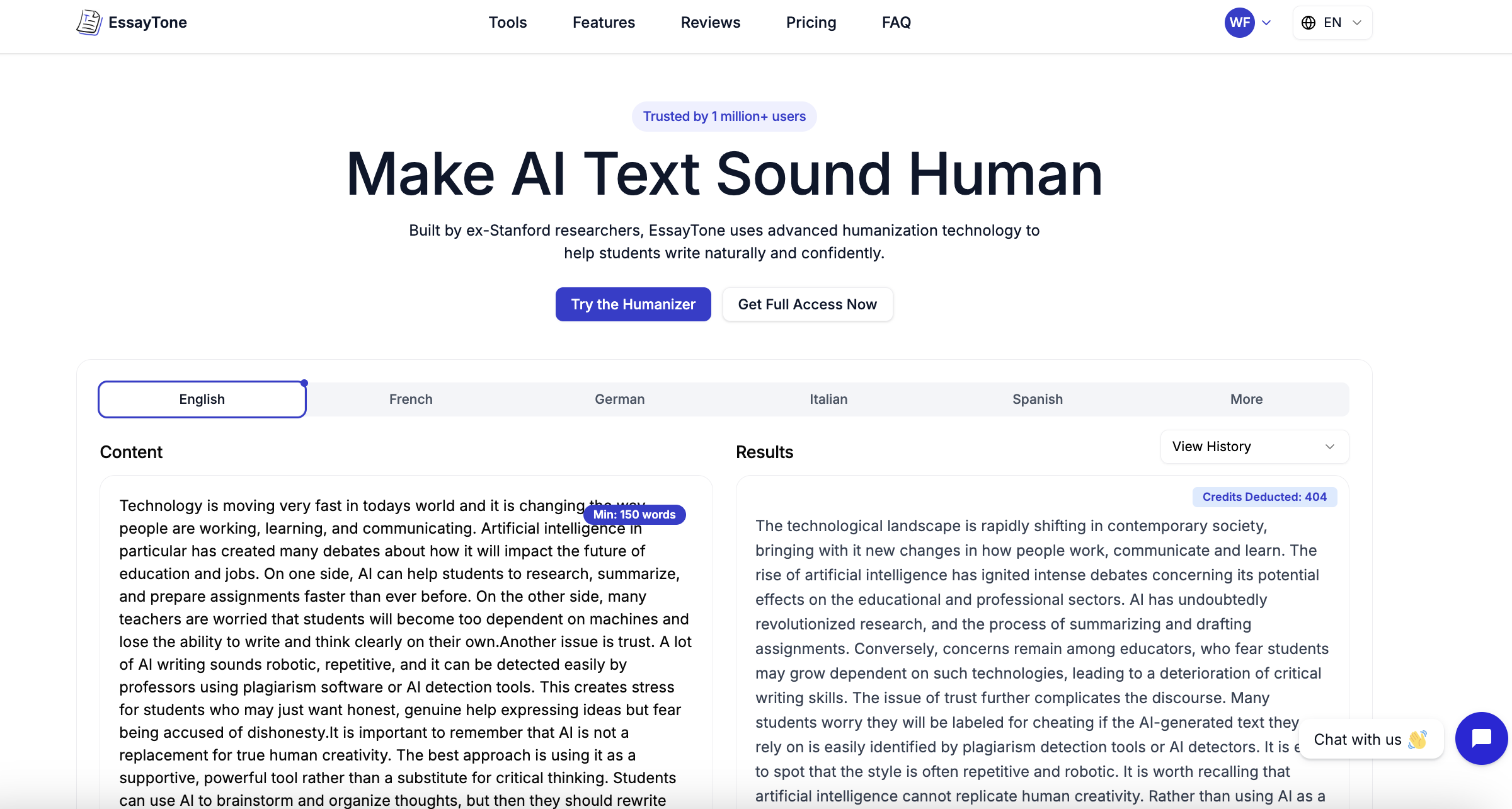
We ran 100 samples of AI-generated text through EssayTone and recorded the before-and-after detector scores on three separate systems. The dataset was built to be hard to argue with:
- Source models: GPT-4, Claude, Gemini, DeepSeek, and Llama, 20 samples each, so nothing gets skewed by one model's writing tics.
- Length: 355 to 791 words per sample, averaging around 541, which covers the normal essay and article range.
- Detectors: every sample scored on GPTZero, Winston AI, and Copyleaks, both before and after.
- Meaning check: each output reviewed against its source to decide whether the meaning survived. A strict yes or no, no partial credit.
- Readability: grade-level readability tracked before and after, to confirm the text was getting cleaner rather than scrambled.
A benchmark only counts if the numbers reproduce. Everything below is computed straight from the 100-sample run. No rounding up, no wishful estimates.
What the Numbers Showed
Across all 100 samples, EssayTone cut AI-detection scores hard and did it consistently:
| Detector | Avg Score Before | Avg Score After | Avg Reduction |
|---|---|---|---|
| GPTZero | 96.5% AI | 36.2% AI | 62.3% |
| Winston AI | 97.1% AI | 33.3% AI | 65.6% |
| Copyleaks | 95.5% AI | 35.4% AI | 62.7% |
The threshold numbers tell it even plainer. After running through EssayTone, output dropped below the 50% AI line in 92% of samples on GPTZero, 100% on Winston AI, and 97% on Copyleaks.
Then there's the part most humanizers quietly fail at. 80% of samples kept their original meaning under strict review, and readability actually improved by about 2.1 grade levels, sliding from roughly 11.2 down to 9.0. That readability shift is the tell that the text got more readable, not destroyed. Any tool can beat a detector by chopping your essay into nonsense. Doing it while the writing still says what you meant is the hard part, and it's the part that separates a humanizer from a blender.
The results also held steady no matter which AI wrote the draft. GPTZero reductions ran from 60.6% on Claude text up to 64.4% on Gemini, with GPT-4, DeepSeek, and Llama landing in the middle. Whatever model produced the original, EssayTone pulled it down by roughly the same margin.
StealthGPT AI vs EssayTone, Side by Side
| StealthGPT AI | EssayTone | |
|---|---|---|
| Main purpose | All-in-one bypasser, checker, and writer | Focused AI humanizer |
| Independent detector results | Still flagged as AI: up to 100% on Originality.ai, 86% on Turnitin in 2026 testing | 62 to 66% average reduction across GPTZero, Winston, Copyleaks (100-sample benchmark) |
| Meaning preserved | Often needs heavy manual editing, per reviews | 80% preserved under strict review |
| Readability impact | Output frequently needs cleanup | About 2.1 grade levels more readable on average |
| Philosophy | Width: many tools, one bill | Depth: one job, done well |
The shape of it is hard to miss. StealthGPT AI spreads itself across a dozen features and, by independent testing, stumbles on the one job most users came for. EssayTone does less and has the benchmark to back up the thing it does.
So Which One Should You Actually Use?
If you want a wall of buttons and you don't mind editing the output by hand afterward, StealthGPT AI gives you plenty to click. But if your real goal is simple, take AI-written text and make it read like a human wrote it, without losing what it was supposed to say, the focused tool is the one that delivers. The data isn't subtle about it.
EssayTone was never trying to be everything. It was built to be the best AI humanizer at the single thing that matters, and the 100-sample benchmark is there so you don't have to take that on faith. If you're comparing humanizers right now, that's the one worth running your text through first. Try it on a draft you've already had flagged and watch the score move.
Frequently Asked Questions
Is StealthGPT AI detectable?
By multiple independent 2026 reviews, yes. StealthGPT-humanized text has been flagged by Originality.ai at 100% confidence, by Turnitin as high as 86%, and by GPTZero in published testing. Detector updates seem to have moved faster than its rewriting engine.
How is EssayTone different from StealthGPT AI?
StealthGPT AI is a broad platform that bundles a bypasser, a checker, and a writer. EssayTone is a focused AI humanizer and nothing else. In a 100-sample benchmark it cut AI-detection scores by 62 to 66% on average across GPTZero, Winston, and Copyleaks while keeping the meaning intact in 80% of cases.
Does EssayTone keep the original meaning?
Yes. Under strict before-and-after review across 100 samples, 80% held onto their original meaning, and the output averaged about 2.1 grade levels more readable.
Which AI humanizer should I try first?
If beating detectors while keeping readable, meaningful text is the goal, start with EssayTone and run a flagged draft through it. The benchmark numbers are public so you can check the result against your own.
Methodology: detector scores are each tool's reported likelihood that text is AI-generated. "Reduction" is the average per-sample relative drop from the before score to the after score across all 100 samples. Source models tested were GPT-4, Claude, Gemini, DeepSeek, and Llama, 20 samples each.